Table Tennis Table Dimensions: Official Size, Height and Room Space
The official size of a table tennis table, the net height, how much room you need around it, and what to check before buying a table for home or club use.
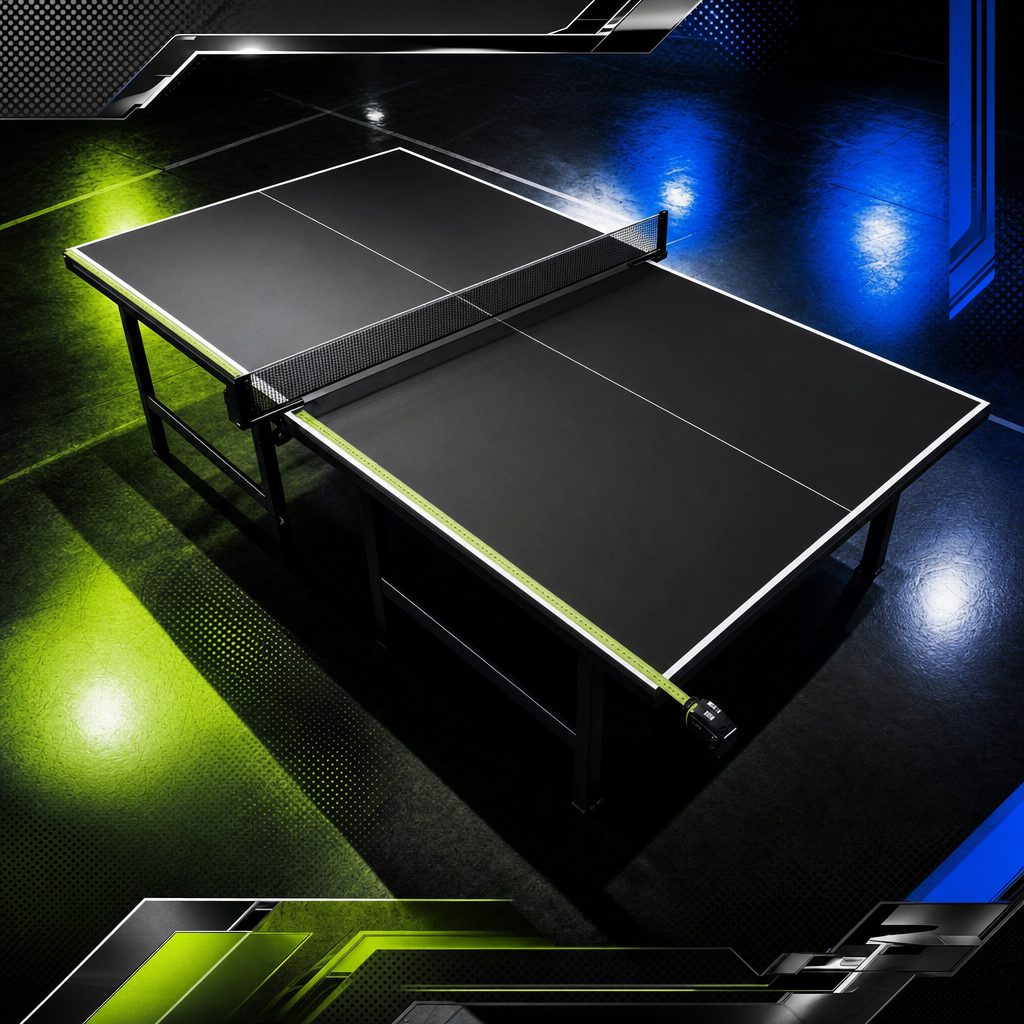
Every table tennis table used in competition, from a county league match to the Olympic final, has the same playing dimensions. Those measurements are set out in the laws of table tennis published by the International Table Tennis Federation (ITTF), and they are worth knowing whether you are buying a table for the garage, setting up a club hall or checking that a venue is suitable for league matches.
The Official Measurements
The laws define the table by its playing surface, the upper flat area on which the ball bounces.
- Length: 2.74 m (9 ft)
- Width: 1.525 m (5 ft)
- Height: 76 cm (2 ft 6 in) from the floor to the playing surface
The surface must be horizontal and can be made of any material, as long as it gives a uniform bounce. The laws describe that bounce precisely: a standard ball dropped from 30 cm onto the surface should bounce up about 23 cm. A table that passes that test feels consistent wherever the ball lands. A table that fails it, with dead spots near the legs or edges, is frustrating to play on however good it looks.
Lines and Markings
The playing surface is dark and matt, usually blue or green, with white lines:
- Edge lines: a 2 cm white line along each 2.74 m side and each 1.525 m end.
- Centre line: a 3 mm white line running down the middle of the table, parallel to the side lines.
The centre line only matters in doubles, where the serve must travel diagonally from the server’s right half court to the receiver’s right half court. In singles it has no effect on play. The full doubles rules are explained in our guide to table tennis doubles.
The Net Assembly
The net assembly consists of the net, its cord, the supporting posts and the clamps that attach them to the table.
- The top of the net must be 15.25 cm above the playing surface along its whole length.
- The posts are 15.25 cm high, and their outside edges sit 15.25 cm outside the side line.
- The bottom of the net should sit as close to the playing surface as possible, and the ends as close as possible to the posts.
Because the net extends beyond the side lines, a ball that travels around the post and lands on the opponent’s side is a legal return, even if it never passes over the net itself. It is a rare shot at club level, but it explains why the posts are placed outside the table.
When setting up, check the net height at the centre and at both ends. Cheap clip-on nets often sag in the middle or sit too high at the posts, which changes how the table plays more than most players realise.
How Much Space Do You Need?
The table itself is only part of the footprint. Table tennis is played well behind the end line, especially once players start to loop and counter-hit, so the space around the table matters as much as the table.
Competition halls allow several metres behind each end and generous space to the sides, with surrounds separating one table from the next. At home or in a small club, practical minimums look like this:
- Casual play: about 1.5 m behind each end and 0.75 m to each side. Rallies will be short and players will feel cramped.
- Comfortable club-style play: about 2 m or more behind each end and 1 m or more to each side, roughly 7 m by 3.5 m in total.
- Ceiling height: at least 2.5 m for normal play, more if players like to lob from deep.
Lighting also matters. Even, glare-free light over the whole table makes the ball much easier to read than a single bright bulb above the net. Dark, plain backgrounds behind each end help too, which is why many club halls use dark curtains or surrounds.
Choosing a Table: What to Check
When buying a table, the dimensions are fixed, so the real differences are in construction.
Top thickness. Indoor tables commonly range from about 12 mm to 25 mm. Thicker tops give a more consistent, livelier bounce. Tables in the 19 mm to 25 mm range are the most common choice for clubs and serious home players, while thin tops suit occasional family use.
Frame and legs. A rigid frame with adjustable feet keeps the playing surface level on uneven floors. Wobble at the corners shows up immediately in the bounce.
Folding and storage. Most modern tables fold into two halves on wheels. Check how easily the halves fold and lock, and how much floor space the folded table needs.
Indoor or outdoor. Outdoor tables use weatherproof tops, often melamine resin or aluminium composite, and galvanised or powder-coated frames. They survive rain and sun but usually play with a lower, less consistent bounce. Indoor tables left in damp garages can warp, so consider where the table will actually live.
Approval. Tables used in sanctioned competition can carry ITTF approval. For home and league use, a table does not need to be approved, but matching the official dimensions and bounce makes practice transfer directly to match play.
Junior and Mini Tables
Smaller “mini” or junior tables are widely sold for children and small rooms. They are useful for learning basic strokes and for fun, but rallies on a small table do not develop the footwork and timing needed for the full-size game. For young players who are serious about the sport, a full-size table, perhaps with a lowered stance and plenty of coaching, is the better long-term choice.
Putting It Together
A regulation table is 2.74 m by 1.525 m, 76 cm high, with a net 15.25 cm above the surface. Those numbers never change. What does change is the quality of the bounce, the stability of the frame and the space you leave around the table. Get those right and the table will play like the ones you meet in league matches.
For more on equipment, see the table tennis equipment guide, and for the rules that apply on that table, the complete rules guide.
Common Questions
What are the official dimensions of a table tennis table?
The playing surface is 2.74 m long and 1.525 m wide, and it sits 76 cm above the floor. Those figures come from the laws of table tennis and are the same for every level of play, from club leagues to the Olympic Games.
How high is a table tennis net?
The top of the net must be 15.25 cm above the playing surface along its whole length. The posts holding it sit 15.25 cm outside each side line, so the net overhangs the table slightly on both sides.
How much room do I need for a table tennis table at home?
For enjoyable rallies, allow at least 2 m behind each end and around 1 m either side, which means a space of roughly 7 m by 3.5 m. Smaller rooms work for casual play, but players will be cramped at the ends. See the beginners guide for getting started.
Do outdoor tables have the same dimensions?
Yes. Good outdoor tables use the same playing surface size and height as indoor tables. The difference is in materials: weatherproof tops and frames that cope with rain and sun, which usually play with a slightly lower and less consistent bounce.