How to Choose a Table Tennis Rubber: Sponge, Hardness and Colour
How to choose a table tennis rubber: inverted, pimpled and anti-spin types, sponge thickness and hardness, ITTF approval and the rules on colour.
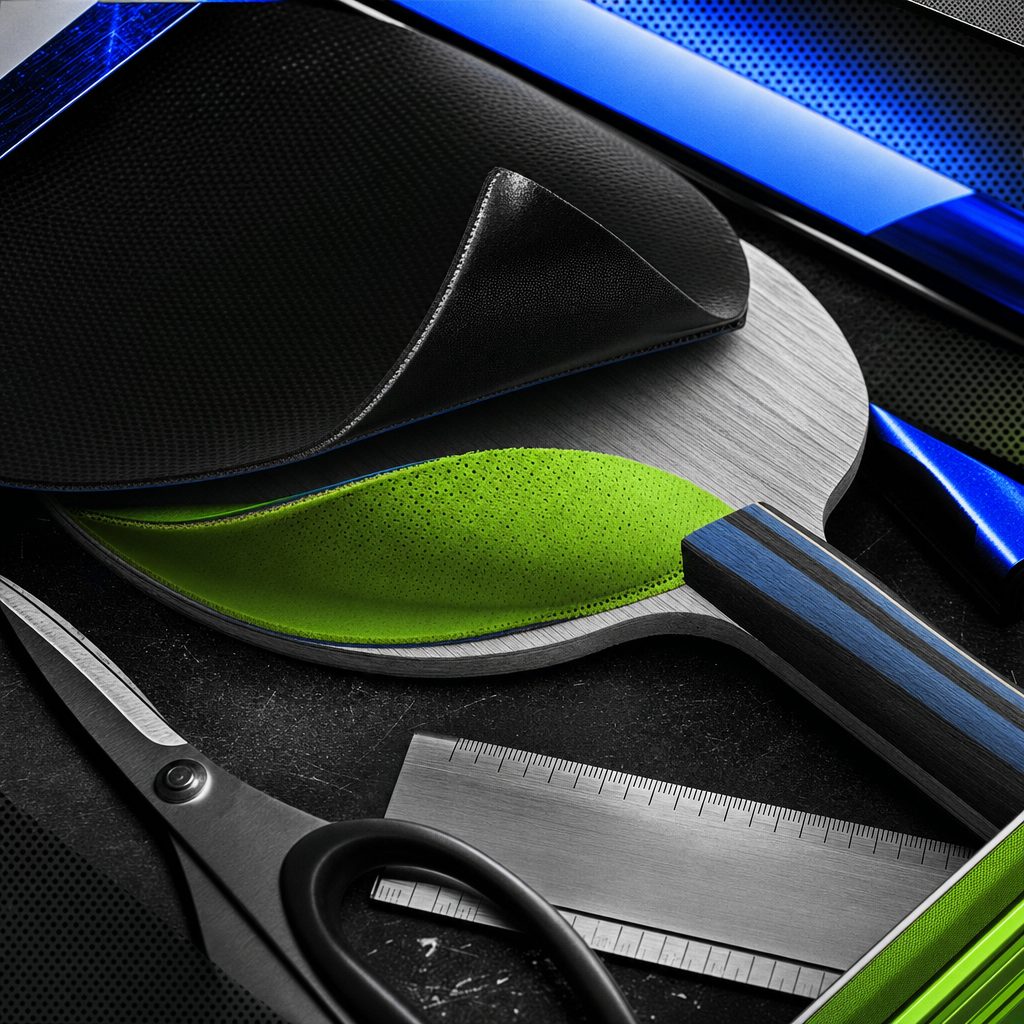
The rubber is the part of the racket that touches the ball, and it shapes how much spin, speed and control a player has. Two players with the same blade can have rackets that feel completely different because of their rubbers. Choosing well makes learning easier and lets a developing player’s strokes work as they should.
This guide explains the main types of rubber, the specifications that matter and the rules that apply in competition.
The Main Types of Rubber
Inverted (smooth) rubber. The most common type by far. The pimples face inwards, towards the sponge, leaving a smooth, grippy surface on the outside. Inverted rubbers produce the most spin and suit the topspin-based attacking game that dominates modern table tennis. Almost all beginners should start with inverted rubber on both sides.
Short pimples. The pimples face outwards and are short and wide. Short pimples are less affected by incoming spin and suit fast, flat hitting close to the table. They are a specialist choice, usually on the backhand.
Long pimples. Longer, thinner pimples that bend on contact and tend to return the opponent’s spin in an unusual way. They are mainly used by defenders and blockers, and are difficult to play with and against. The laws limit the shape and length of pimples on all pimpled rubbers.
Anti-spin. A smooth rubber with a very low-friction surface, designed to neutralise spin. It produces little spin of its own, and is rarely used beyond specialist defensive styles.
Sponge Thickness
Most inverted rubbers are sold with a choice of sponge thickness, usually from about 1.5 mm up to “max”, which is typically 2.1 mm to 2.3 mm depending on the brand. The laws limit the total thickness of a rubber with sponge to 4 mm, including the adhesive.
- Thinner sponge (around 1.5 mm to 1.8 mm): more control, lower speed, easier to feel the ball. A good choice for beginners and for players who block and control more than they attack.
- Thicker sponge (2.0 mm to max): more speed and spin on full strokes, a higher throw and less feel on soft touch shots. Most advanced attacking players use the thickest sponges.
A common choice is a slightly thinner sponge on the backhand than on the forehand, which makes blocking and short play easier.
Sponge Hardness
Manufacturers rate sponge hardness in degrees, but different brands use different scales, so numbers are not directly comparable between brands.
- Softer sponges compress easily, holding the ball longer and giving good control and spin on slower strokes. They are forgiving for developing players, but can feel overpowered by very hard hitting.
- Harder sponges need more speed and better technique to use fully, but reward strong strokes with more power and a flatter trajectory. Many hybrid and Chinese-style rubbers use hard sponges.
For most club players, medium hardness is the sensible starting point.
Tacky, Tensor and Hybrid Rubbers
Inverted rubbers fall into three broad families:
- Tensor-style rubbers, common among European and Japanese brands, have a grippy but not sticky surface and a lively, springy sponge. They generate speed and spin easily, even with shorter strokes.
- Tacky rubbers, associated with Chinese brands, have a sticky surface that grips the ball strongly and a hard sponge. They produce heavy spin, especially on serves and short play, but need strong technique to generate speed.
- Hybrid rubbers combine a tacky or semi-tacky topsheet with a livelier sponge, aiming for the best of both. They have become popular since the introduction of the plastic ball, as explained in our guide to hybrid rubbers.
Colour Rules
For many years, the laws required one side of the racket to be red and the other black. Since 1 October 2021, the ITTF has allowed more colours:
- one side must be black;
- the other side can be red or one of the approved bright colours: pink, violet, green or blue.
The colours must be clearly distinguishable from each other and from the ball. The rule exists because players read spin partly by seeing which side of the racket the opponent uses, so two identical-looking sides would make that impossible.
ITTF Approval
For any competition played under the laws of table tennis, rubbers must appear on the ITTF list of authorised racket coverings. Approved rubbers carry the ITTF logo, the manufacturer’s name and the brand name near the handle. They must be used as supplied, without physical, chemical or other treatment.
For casual play at home, approval does not matter. For league matches and tournaments, it does, so check before buying from unfamiliar suppliers.
Matching Rubber to Blade
The rubber and blade work together. A fast carbon blade paired with fast, thick rubbers can be very hard to control for a developing player, while a slower all-wood blade with medium-thickness rubbers is a good learning combination. Our guide to best value carbon blades covers blade options in more detail.
A Simple Starting Point
For a player moving on from a pre-made bat, a reliable choice is:
- inverted rubber on both sides;
- medium hardness;
- around 1.8 mm to 2.0 mm sponge on the forehand, and the same or slightly thinner on the backhand;
- a control-oriented all-wood blade.
That combination supports good technique while leaving room to move to faster equipment later. When choosing between models, trying a club-mate’s racket for a session is often more useful than reading specifications.
For more, see the full table tennis equipment guide, and for advice on getting started, the beginners guide.
Common Questions
What sponge thickness should a beginner choose?
A medium sponge of around 1.5 mm to 1.8 mm suits most beginners. It gives enough control to learn strokes properly, without the extra speed of the thickest sponges that punishes small errors.
What colours can table tennis rubbers be?
One side of the racket must be black. Since 1 October 2021, the other side can be red or one of the newer approved bright colours: pink, violet, green or blue. The two sides must always be clearly different.
Do rubbers need to be ITTF approved?
For competition, yes. Each rubber must be on the ITTF list of authorised racket coverings and carry the ITTF logo and approval markings near the handle. For casual play, any rubber can be used.
How often should rubbers be replaced?
It depends on how much you play. Regular club players often replace rubbers every few months, when the surface loses grip and the ball starts to slide off rather than bite. See the equipment guide for care tips.